A smarter nestrrr score
How nestrrr compares rent, size and local demand without letting thin data or suspicious prices fool the ranking.
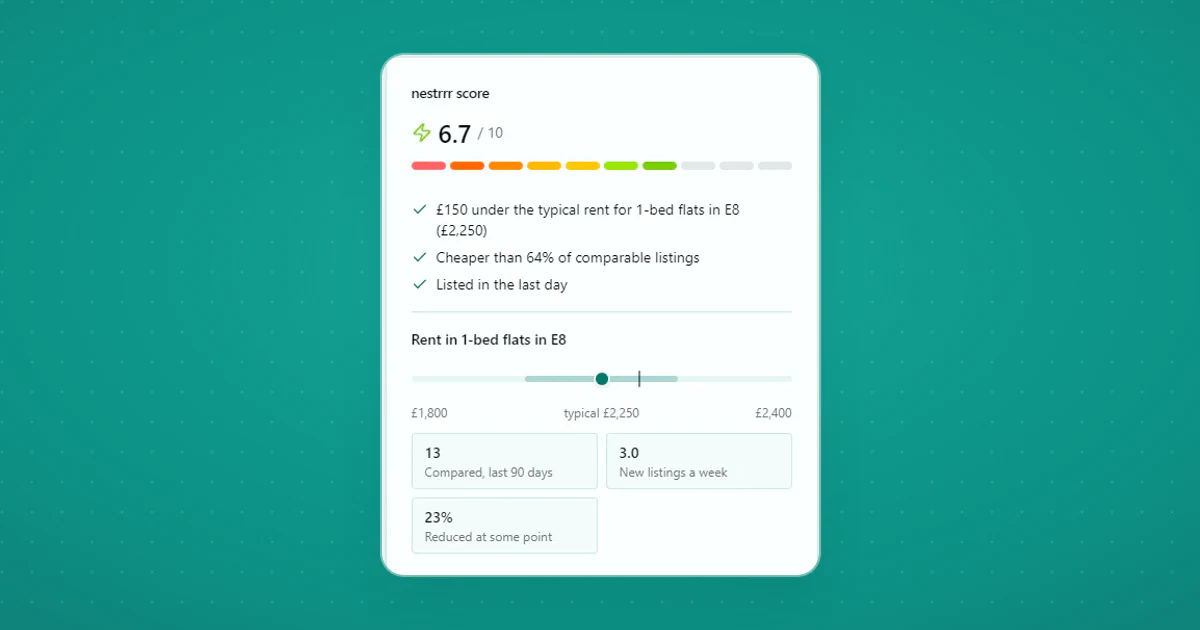
The nestrrr score is a quick read on how a listing compares with similar homes nearby. It is not a verdict, and it should never hide how it reached the number.
We have rebuilt some important parts of the calculation to make it steadier, fairer and harder to fool.
The listing that started it
An Islington room once scored 0.3 because it was £924 above the local average. The number was technically right, but the comparison was not. It was a double with an en-suite, a bay window and garden access.
Treating that like a basic room made the score useless.
Like for like
Before comparing rent, nestrrr now allows for what comes with the home:
- Bills included. We allow about £150 a month for a room and £250 for a whole home.
- En-suite rooms. We allow for the usual premium before comparing it with other rooms.
- Single rooms. We stop small rooms looking like bargains just because they are small.
Every comparable listing gets the same treatment. The asking rent shown on the property never changes, and the score explains each adjustment.
We have also tightened how those facts are read. If a listing explicitly says bills are extra, a stray phrase elsewhere can no longer make nestrrr treat them as included. Street names such as "Kew Gardens" and descriptions such as "Victorian terrace" no longer count as outdoor space.
Size without the price-per-foot trap
A small flat should not look like a bargain merely because it is cheaper. But price per square foot creates the opposite problem: large homes almost always look better because rent does not rise in a straight line with every extra foot of floor space.
nestrrr now uses a gentler size adjustment. A larger home is expected to cost more, but not in direct proportion to its area. That keeps genuinely compact homes from being overrated without automatically handing the highest score to the biggest one.
The size comparison only runs when the listing and enough nearby comparables state their floor area. Otherwise, nestrrr falls back to the like-for-like rent comparison rather than guessing.
More confidence when there is more evidence
Eight comparable listings can reveal something useful, but they cannot support the same certainty as eighty.
The score now accounts for sample size. Results from a small pool are pulled closer to the middle; results backed by a larger local market can move further towards the top or bottom of the scale. The explanation also shows how many comparable listings were used, so the confidence is visible rather than hidden.
Homes at the same rent are treated as tied too. A popular round-number rent such as £1,000 no longer gets an artificial advantage just because it appeared first in a percentile table.
Too cheap to trust blindly
A listing far below every comparable home may be an extraordinary bargain. It may also be a weekly rent mistaken for a monthly one, a room filed as a whole flat, a restricted scheme or a scam.
Previously, those listings could receive a perfect 10 and become the most urgent alert of all. They are now capped at 7.0—still worth looking at, but never presented as an unquestionable bargain. The first reason tells you to check that the property is what it says it is.
How fast homes go
Price is only part of the decision. nestrrr also measures how many similar listings disappear within a week. If homes nearby move quickly, the score says so.
You might see: "52% of rooms in N1 go within a week". That is useful context when deciding whether to book now or think overnight.
We also fixed missing departures in that calculation. If a property is found to have been removed while nestrrr is enriching its details, that change now feeds into the local pace just like a normal status update.
Fresher signals and plainer reasons
"Listed in the last day" now means the last 24 hours, not nearly two days because of calendar rounding. "Price reduced this week" likewise means the last seven full days.
The reasons are plainer too. Instead of "cheaper than 0% of comparable listings", it says "dearer than all 24 comparable listings". When size is involved, it says so directly.
The result is not a mysterious recommendation engine. It is a transparent comparison: similar homes, adjusted for the facts we know, tempered by the amount of evidence and explained beside the score.
If a score still looks wrong, send it through the feedback button. That is how the calculation keeps getting better.